We have a very beautiful modern stained glass window in my church, St Marys Luton. The Magnificat Window was created and installed in 1978 by stained glass window artist of repute, Alan Younger. It is simply glorious! However the truths it speaks of are even more stunning.
(I wrote the heart of this early on after we launched St Mary’s Centre for Peace and Reconciliation, and it was posted on our centre’s blog. the things I touch on remain central to my life and calling. A couple of weeks back I asked attendees at our Thursday morning informal worship to reflect on the window and the Song of Mary which inspired it.)
In the early years of my work in Luton we would gather as a church team several days each week under that window to pray. Many times as we prayed for our peace-building work we prayed and reflected on things that were taking place in Luton, and we sought God fervently for understanding and leading. Many were the occasions when I'd look up at the window and be inspired. The window and the message in it became a central part of the growing work of peace and reconciliation. As such when we set up St Mary’s Centre for Peace and Reconciliation we asked that our logo be themed on it.
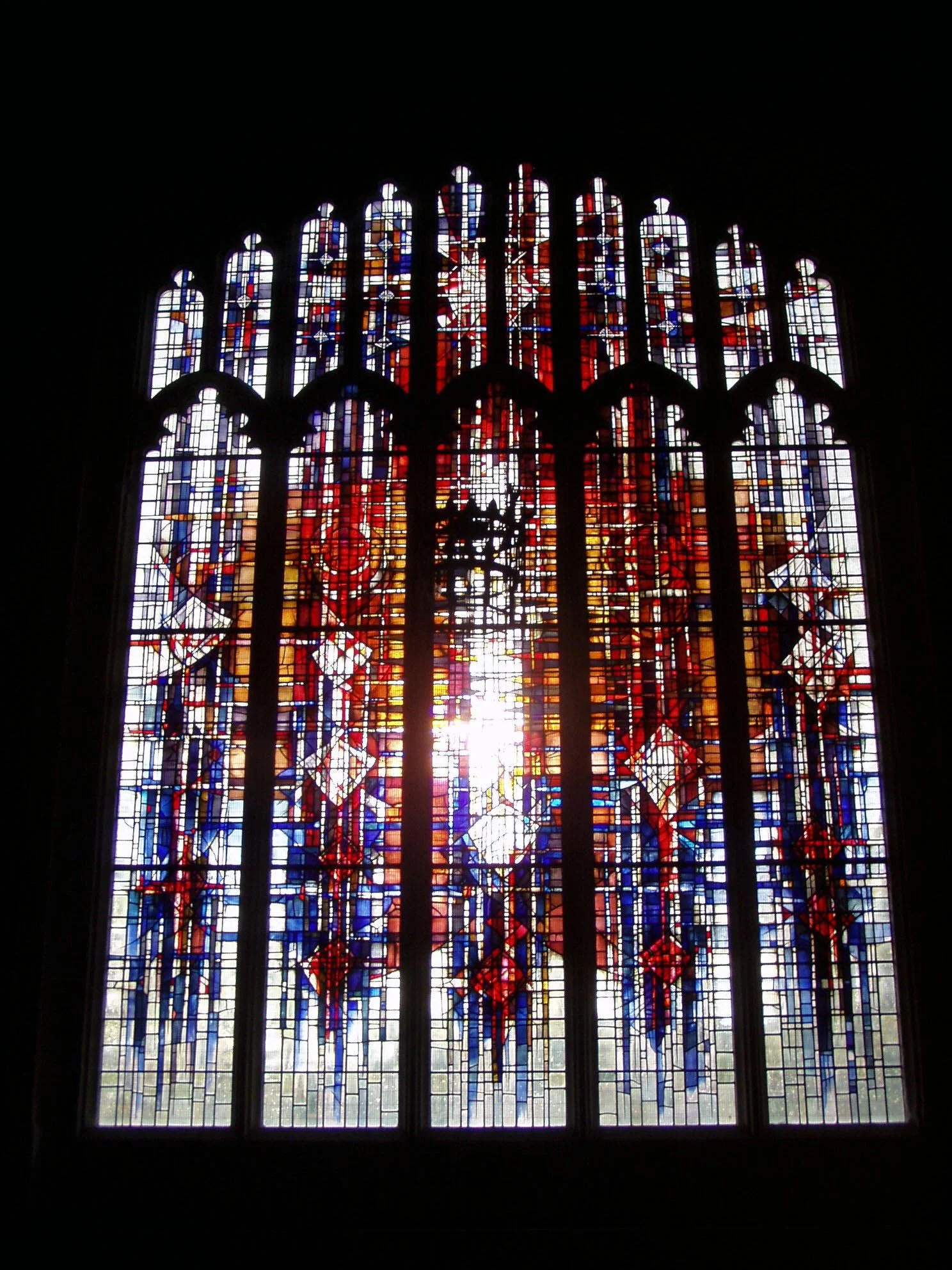
The artist’s inspiration was the Song of Mary, reportedly sung by the mother of Jesus a while after she received from the angel the news she was pregnant with a son, who would be a king for ever! Without going into the theology here, this was rather unexpected news to her - as she noted to the angel while she was engaged to be married she was still a virgin! No problem the angel replied, it's the work of the Holy Spirit. Moreover “Nothing will be impossible with God!” Soon after hearing this message Mary headed to see her cousin Elizabeth, and while there burst out in exaltation of God at the news she had been thinking on.
The Song of Mary, often called the Magnificat, is one of the oldest Christian hymns of worship, and has been sung by the church since that time. This isn't the place to go more into the Magnificat, the window, it's inspiration, and Alan Younger the artist - there's more on that on the St Marys website.
What made this important for us at St Mary’s Centre for Peace and Reconciliation are these words at the heart of the song:
He has performed mighty deeds with his arm;
he has scattered those who are proud in their inmost thoughts.
He has brought down rulers from their thrones
but has lifted up the humble.
He has filled the hungry with good things
but has sent the rich away empty.
(Luke 1.51-53)
Marys song reminds us that right at the heart of God’s purpose for Jesus, right at the heart of Christian message was peace and justice, and social change!
Many words have been written about this song by theologians and preachers, but perhaps less commonly by social activists. I'll restrict my choice to a sermon preached by Christian martyr Dietrich Bonhoeffer in December 1933, then serving in Forest Hill in south London. He begins:
“This song of Mary's is the oldest Advent hymn. It is the most passionate, most vehement, one might almost say, most revolutionary Advent hymn ever sung. It is not the gentle, sweet, dreamy Mary that we so often see portrayed in pictures, but the passionate, powerful, proud, enthusiastic Mary, who speaks here. None of the sweet, sugary, or childish tones that we find so often in our Christmas hymns, but a hard, strong, uncompromising song of bringing down rulers from their thrones and humbling the lords of this world, of God's power and of the powerlessness of men. These are the tones of the prophetic women of the Old Testament: Deborah, Judith, Miriam, coming alive in the mouth of Mary.” (More here: A sermon preached by Dietrich Bonhoeffer [1] [emphasis mine]
Hitler had just that year come to power in Germany. Bonhoeffer had already spoken out strongly against him, and his policies, especially towards the Jews. Building up a church that would be true to the Christian message in its entirety in the midst of Nazi German would become the defining point of Bonhoeffer’s work until it led him to his death just weeks before the end of the war.
I'm deeply inspired as I reflect on Bonhoeffer’s words. I'm motivated by reading of times when reading of this passage, or use of liturgy based on it, has been banned because it is held to be subversive, to foster revolution. Apparently the Magnificat was excluded from its traditional place in evensong in churches run by the British East India Company in India. Years later Gandhi requested that this song be read in all the places where the British flag was being lowered on the final day of imperial rule in India. The junta in Argentina forbade the song after the Mothers of the Disappeared displayed its words on placards in the capital plaza. And during the 1980s, the governments of Guatemala and El Salvador prohibited any public recitation of the song.
It is our hope as Christians that as we seek peace and justice for all in Luton we will be true to the prophetic challenge of the Magnificat. It's a song for change, a song of revolution! Not a violent revolution, but which still brought the greatest revolution in the story of the cosmos. And we will be reminded of it by our logo!
Our Logo For the centre created by Grant O'Sullivan
[1] http://locusthoney.blogspot.co.uk/2011/12/sermon-on-magnificat-by-dietrich.html