On the last day of November, ‘Tommy Robinson’ announced controversial plans for an event in central London to “Put the Christ back in Christmas.” This took place this past Saturday 13th December, with around 1500 attending. There were reports across the media; for example the Mail (Tommy Robinson leads carol concert 'putting Christ back into Christmas' as Billy Bragg joins counter-protesters) with lots of pictures giving a generally positive feel for the occasion, and the Guardian reported with a few more questions (Tommy Robinson’s London ‘Christmas service’ draws about 1,000 people).
An Observer piece Far right has ‘parked its tanks on the front lawn of the Church of England’, bishop says set the event in the context of a lot of hard work by leaders both in the Church of England and wider church as they sought a nuanced response. Bishop of Kirkstall, Arun Arora, who serves as co-lead bishop for racial justice, summed it up:
“We are in a place now where in the next three to five years there will be a battle for those who want to pursue a kind of UK Maga [Make America Great Again] agenda as to what Christianity is. If the far right are now parking their tanks on the front lawn of the Church of England, how is the church to respond?”
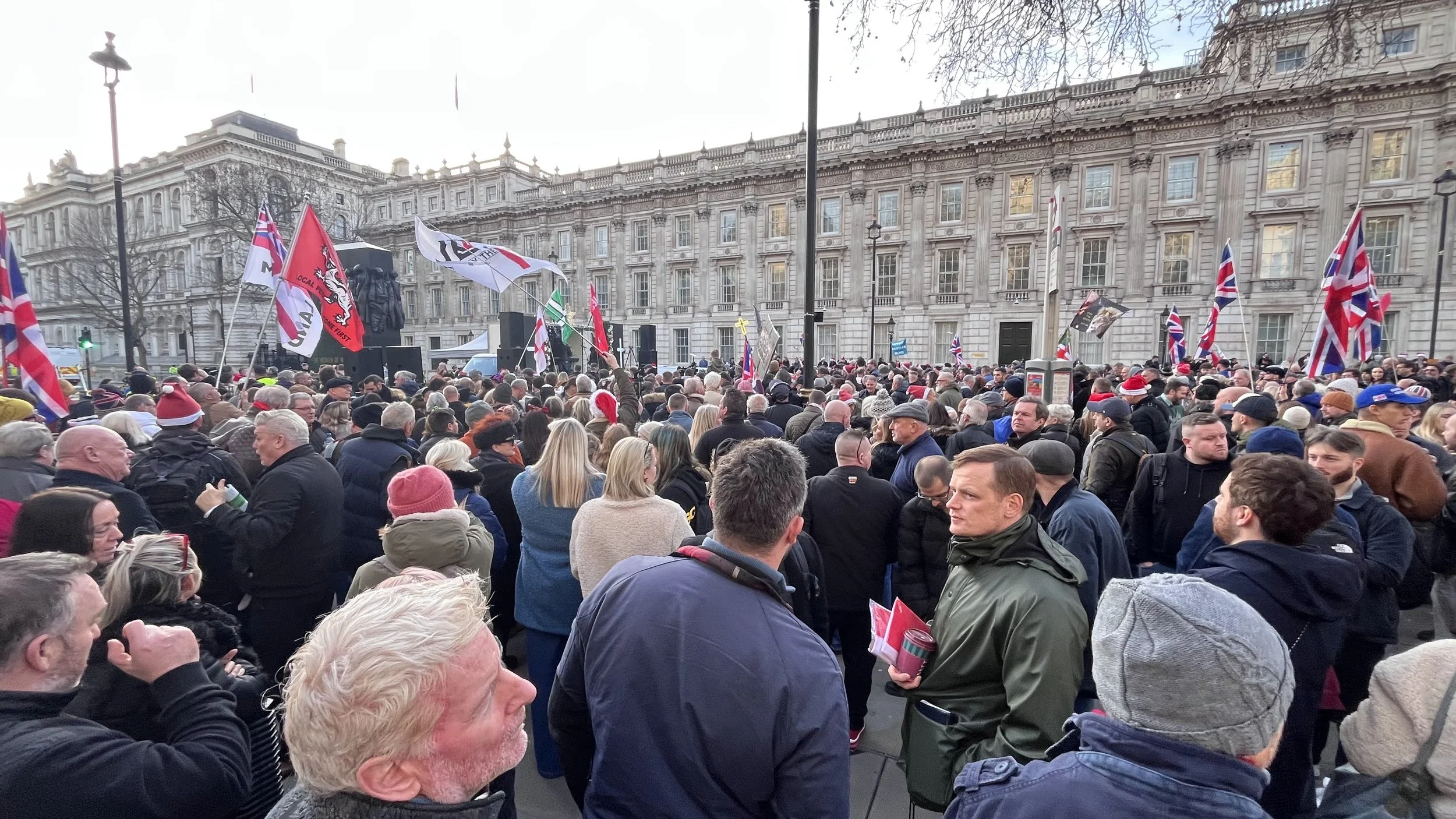
The crowd gathered in Whitehall just up from Downing Street numbered some 1500 people.
Having been very familiar with ‘Tommy’ over the past 16 years since he emerged here in Luton as a street activist for the far right, in particular helping the church and our wider community respond to his activity and wider message, it was with a particular concern to understand this new apparently Christian voice that I attended the Carol Service last Saturday. I offer what follows as my thoughts for a way forward.
————
When i first heard of the intended carol service to “put the Christ back in Christmas” I circulated a short piece around the churches but which I posted here: But Christ never left Christmas!. The story was not true in Luton when I heard it from Tommy in the early days of the EDL, and it is certainly not true now.
However to understand more of what was in mis mind, it seemed very obvious to attend the event in Whitehall on Saturday - one-time fellow citizen of Luton, Stephen Yaxley Lennon (SYL), has been an important focus of my work for over 16 years. [1] I observed the angry protest by him and about 200 others on 10th March 2009 against a small Luton group of members of the extreme Muslim group al-Muhajiroun led by the infamous Anjem Choudary during a homecoming parade of a British army regiment through the town centre. As a civic and community conflict mediator based at the town centre parish church, St Marys, and working across the Luton community, I sought to understand the nature of the emerging street protest movement that became the EDL. Responding to that movement and its legacy has become central to my work. While SYL is now far ‘bigger’ than Luton, and has indeed moved away from the town, his shadow still looms over our lives here, and while the EDL no longer exists, his new focus and its link to his apparent new faith as a Christian, means as a church in the town we are keen to understand this new phase of his life.
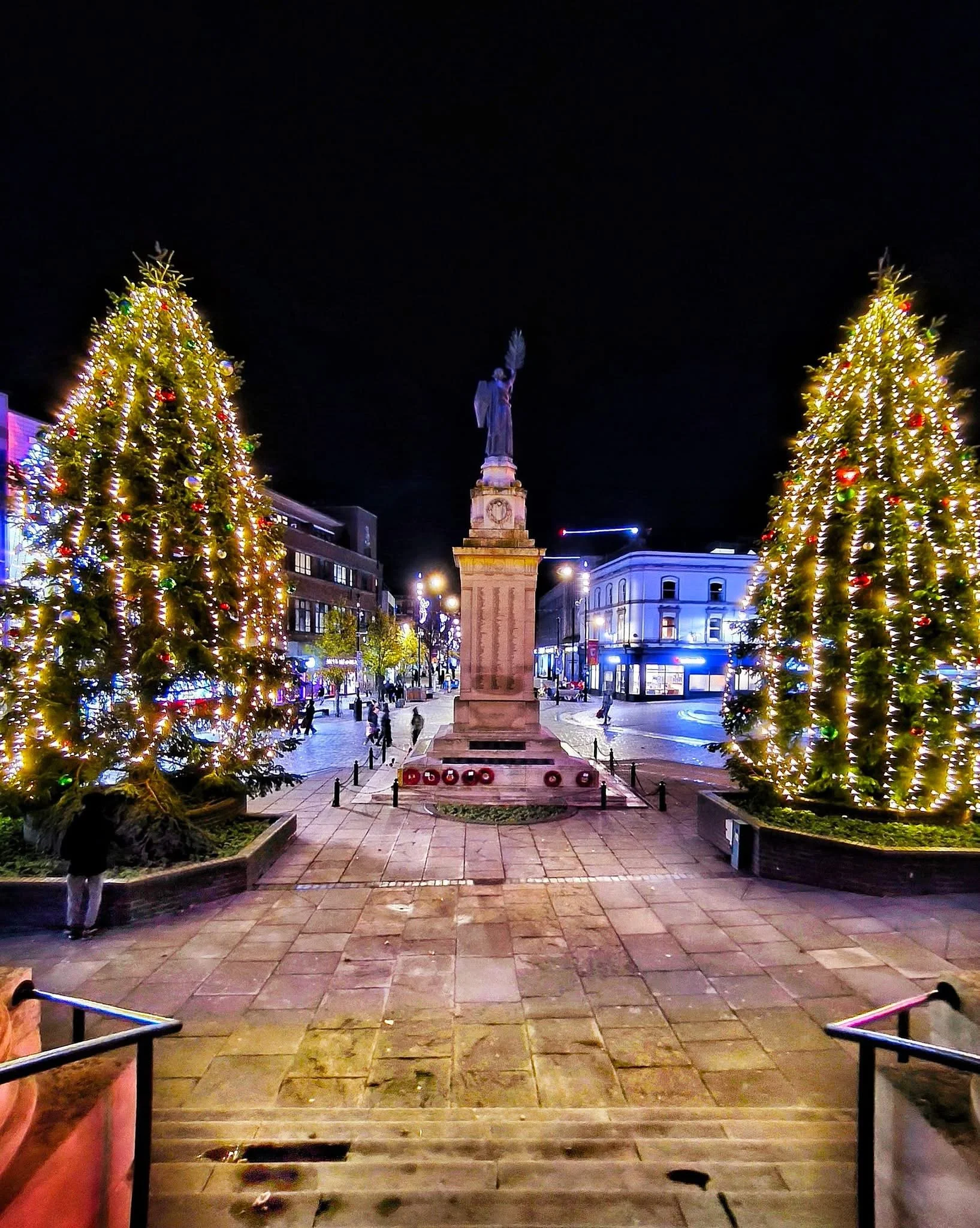
Christmas never left ‘Tommy’s’ home town of Luton, and this year there are more Christmas trees around the town that ever!
Christian questions and concerns.
The event, or carol service as they termed it, was a mix of Christmas carols and songs, Bible reading, testimony of turning to faith and miracles, and short sermons, and included an appeal to respond to the message of salvation. It was a format not unfamiliar with many from a Pentecostal or non-denominational church. It lasted about an hour and 45 minutes. You can watch it on the live feed here. Only after the final blessing did SYL appear (at 2.18.39 on the recording above) to a great applause. Both his manner and message were very restrained in comparison with his normal style.
I wasn’t the only Christian attending in order to watch, listen and understand carefully before speaking further about it. One of these was Nick Spencer, Senior Fellow of Theos who, together with the event’s compere and singer Minister Rikki Doolan, contributed to the report on the event on the BBC Radio 4 Sunday programme, (Here, beginning at about 31.48 with Nick from 38.27). Nick was clear “… the focus was pretty singular on Jesus …” There was none of the focus on Islam or immigration or ‘wokery’ one has come to expect in SYL’s normal material. Nick has reflected further in a Theos blog piece.
Nick’s analysis was shared by my main companion for the day, Baptist theologian Helen Paynter, director of the Centre for the Study of Bible and Violence whose work on has led her to look at the use of violence and the idea of a ‘God of war’ in far-right narrative. Her excellent account (Generosity and Caution) first reviews the people attending, the speakers, and the tone of the event. She moves on to two key themes over which I share her concern, and I make no apology for pointing to her analysis.
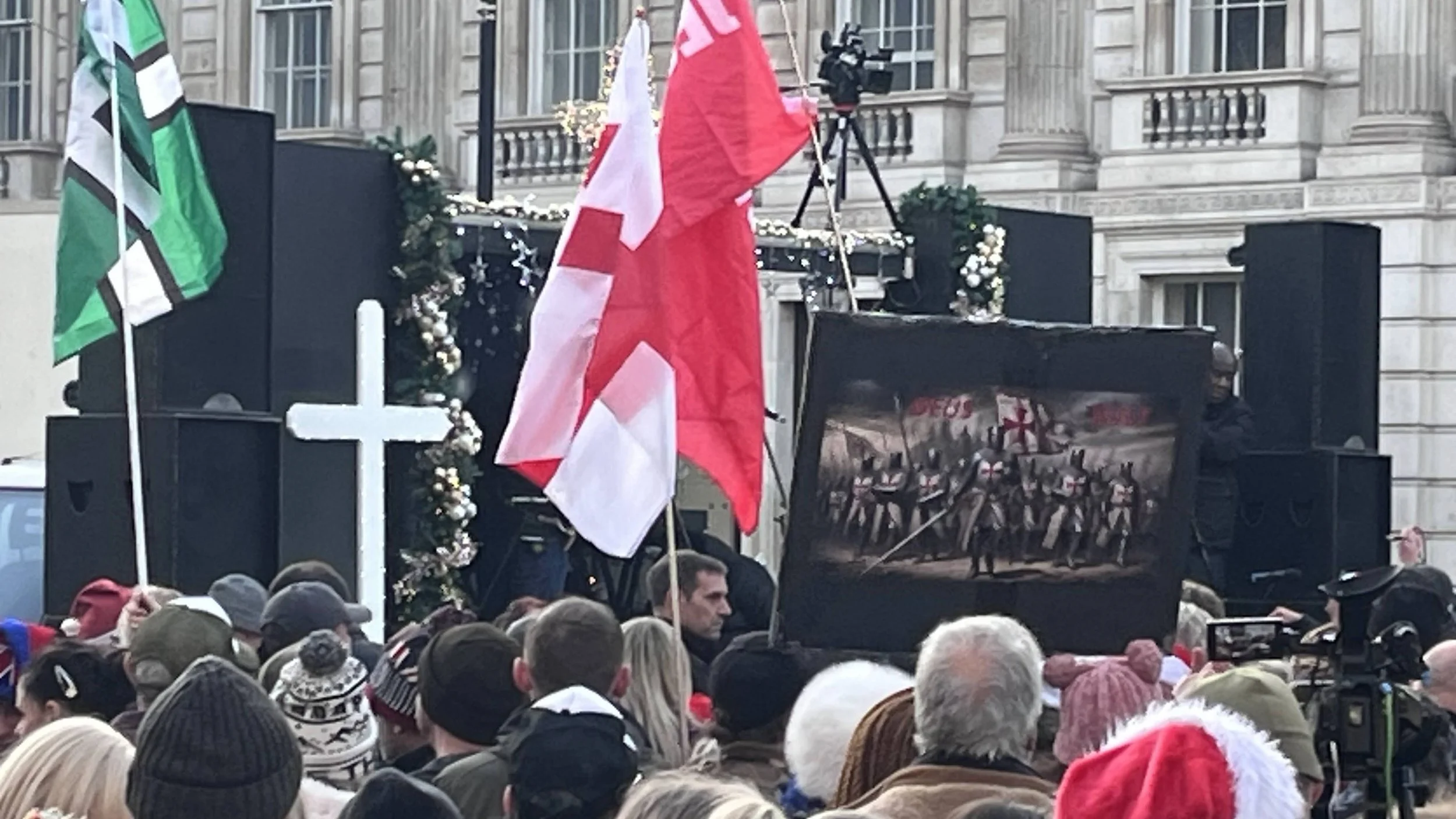
Among the flags and banners displayed by the crowd was one with the 11-12th century Crusader motto Deus vult, ‘God wills it’, their battle cry. Crusader symbolism was a common feature of the EDL as it developed under SYL, and of the wider far right counter-jihad movement. This was perhaps the most inflammatory feature of the event.
Taking Helen’s second point first, we must consider the question of SYL’s conversion. I observed a more softly spoken man on that stage than I have seen over many years. Two people who have known him many years have said the same to me. SU, a peer from his teens who is now a Christian but wasn’t then, says: “Stephen’s emotions on the stage appear to be that of faith. He seemed genuine … I think his anger drives him at the moment and if he could let that go things could take a positive turn.” I find these thoughts very perceptive.
DB, a Christian leader who has sought to reach out to him over many years noted: “Stephen was more subdued and gentle than I had seen before. He showed appreciation of others … thanked… affirmed others. He humbly twice said he knows he lives a life of sin. Stephen did not sound as though he was trying to stir people up. He was not intense and strained, but more gentle. … Something different has happened to Stephen and for it to grow he needs to hear voices [different] to those around him now.”
Both looked for fruit of a changed life. I join them in seeking the fruit of God working in him. Helen Paynter sums this up very graciously:
“So, how might we respond to the Tommy Robinson carol service of 2025, and to his claim to have been converted to faith in Jesus Christ? I suggest: with the wisdom of serpents but with the innocence (optimism?) of doves. This might mean: with tentative generosity of spirit; with (a sliver of) hope but (gracious) caution; with faith in the God who can change the hardest of hearts, and with prayer that we might have the wisdom to discern whether this just possibly might be happening.”
DB speaks directly to this point: “… on the platform were people behaving as people on the platform have always behaved. … to grow in new ways he needs new guidance.”
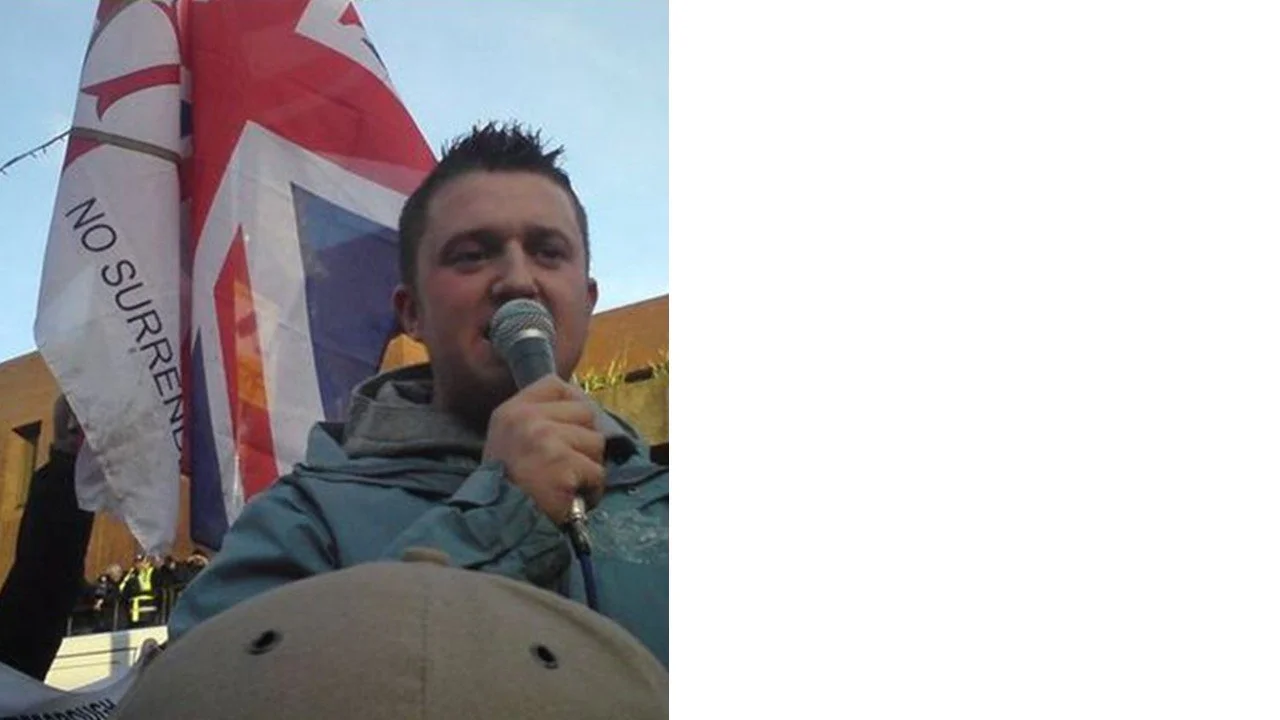
Stephen Yaxley Lennon aka Tommy Robinson during his EDL years.
Helen Paynter’s first point was on what we know SYL’s track record, and especially what he and his colleagues said on the platform of his previous and more typical demonstration, Unite the Kingdom, in September. We also know what the emails to supporters about the Christmas event had a quite different message from the public announcement. (see Jon Kuhrt’s blog). And now, several days on from the event, we also see what he has said about the Bondi Beach Hannukah massacre and its perpetrators. We must not let his sanitised exercise of faith on Saturday deceive us as to the much wider and often aggressive agenda of the movement he leads. Helen Paynter cleverly labels the potential of this ‘Church-washing.’
We are left with the reality that for Doolan, and possibly now for SYL, it is the case that their personal Christian faith and political activism are entirely consistent with an aggressive rhetoric that seems to leave open the way to violence as a valid part of that activism. By contrast I, and many others, would expect SYL’s personal turning to faith to be a time to rethink and shed the aggressive tone and violence, though not I would stress the activism or political engagement. Indeed, Helen Paynter, who understanding the incredulity many of us hold to the possibility of SYL’s conversion, compares it to the way the Saul of early Acts of the Apostles becomes the Paul who was father of much of the early church. She then goes on to note that Saul quickly retreated into Arabia:
“This was time for him to study, to learn, to allow his mind to be transformed and to get onto the right page. It was only after three years that he returned to the church, prayerfully trained-up and ready to be of service. Tommy Robinson might take a leaf out of this playbook.”
By comparison, it seems so far that there is no encouragement in the Christian circle he occupies to seek social justice as a outworking of personal holiness as many of us would expect. It seems that passion for Christ is an acceptable motivation towards rather than restraint from aggression to Muslims. It seems that a good Christian is a good nationalist. In this situation, we are confronted with a forceful and possibly violent form of Christian Nationalism.
The Church v Lennon?
At the centre of what I bring to a commentary on this event must be a closer look at what SYL said. He describes the Saturday event as the most beautiful moment in his life as an activist. He thanks Rikki Doolan for putting it all together. And then:
“When I started in 2009 the church stood again us. In every town and city we went to, as a cry for help as to what was happening ... the church leaders stood and opposed us. That drove me away from Christianity. In fact, I hated the church.”
He goes on to describe how a pastor (clearly Rikki Doolan) showed him something different while he was in prison.
(An aside here. I am hearing the statement above as a cry from the heart. So I want to speak to them personally. Hence I have moved in this section to using ‘Stephen.’)
Stephen’s words have made me think very hard. I was the Christian leader who led the first church response to the growing movement he led when in emerged in Luton. Had I in his own words “driven him away from Christianity?”
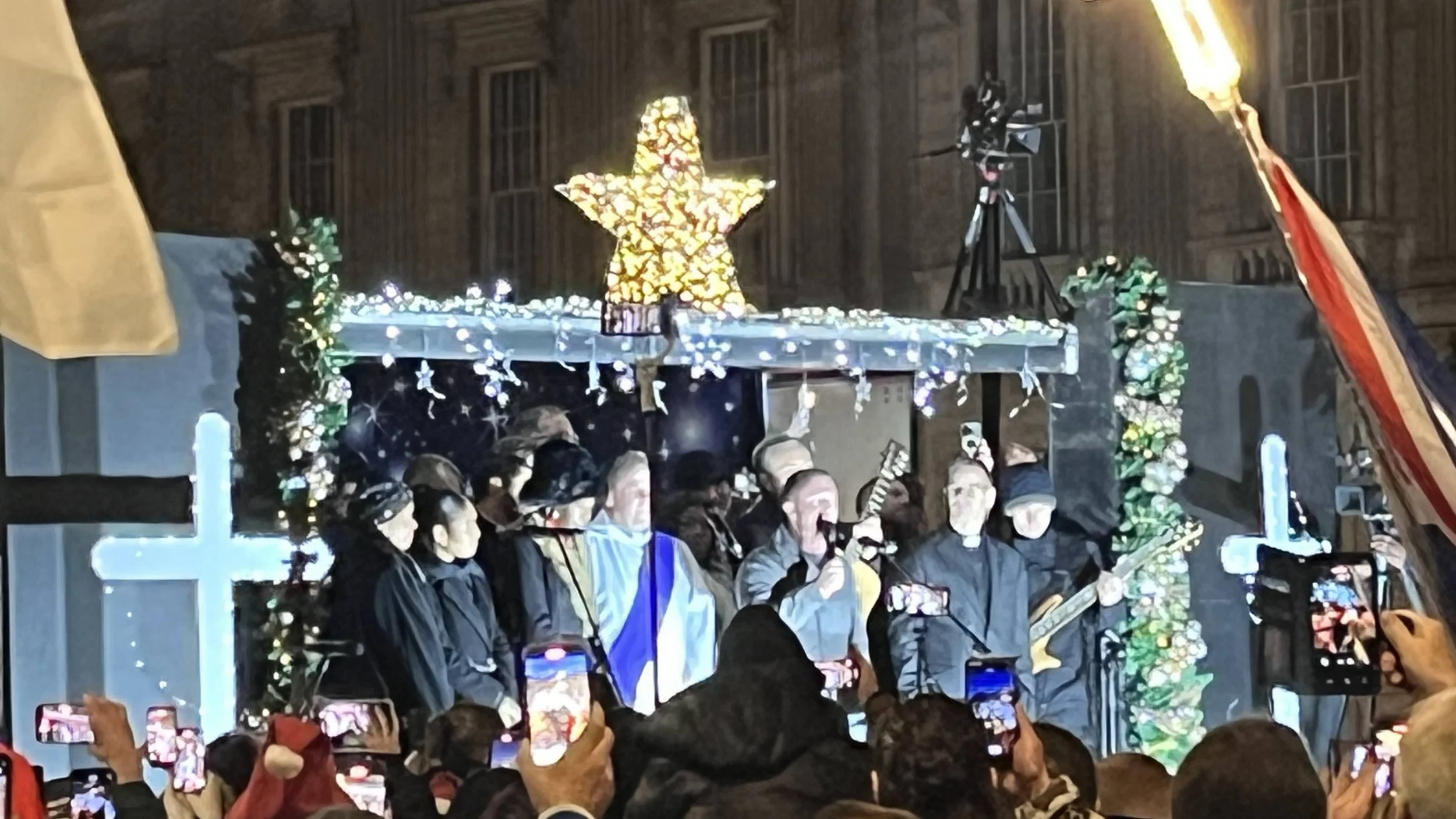
Stephen Yaxley Lennon with Christian leaders speaking at the end of the Carol Service organised by Unite the Kingdom.
His words have made me think over again the challenging months of 2009-10 when what became the EDL began. As Christian leaders in Luton we laboured hard to know how to respond to their demonstrations which were coming thick and fast. A number of smaller demonstrations though the spring led to a large one in late May 2009, when some 500 gathered and some ran amok through the town. We quickly concluded that we had two responsibilities. Firstly, we had to work for peace in the town. Second, while doing this we had to engage with those wanting to protest and seek to understand the roots of their concern. As such it would not be productive to join in counterdemonstrations as too often, they resorted to destructive language in response to many who were friends, even family members, of our own members and parishioners.
To understand what was going on we read their comments on social media posts announcing protests. We reached out to individuals, sat down with them and listened to concerns. We sought to understand this movement pastorally. We discovered those who had close relationship to our churches, who’d been brought up as church goers.
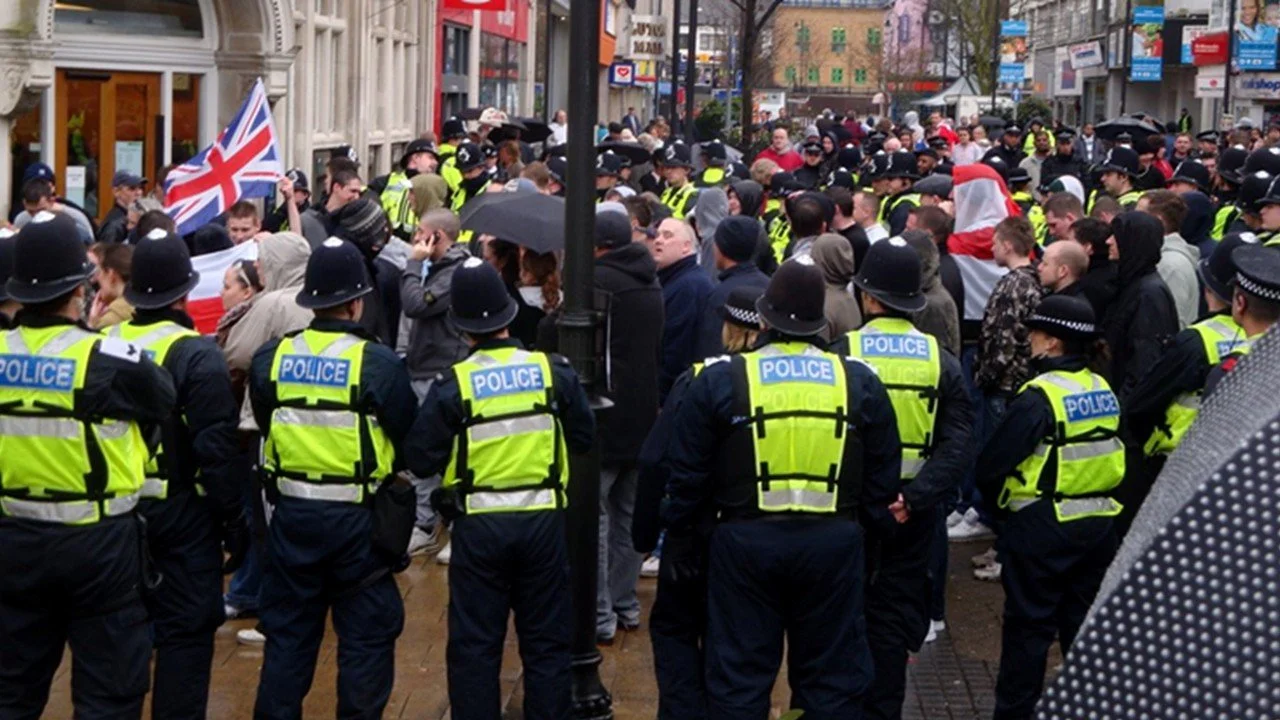
The Luton protest against followers of extremist leader Anjem Choudarywho during an army homecoming parade on 10 March 2009 which led to the formation of the English Defence League (EDL).
At the same time we tried to understand the growing fears and concerns of our Muslim friends, colleagues and neighbours. How did they feel in the face of this aggressive anti-Muslim movement? And crucially we heard their anger at the way the extremism in their community was seeking to define them. It was all brought to a head by the firebombing of a mosque in early May 2009, which clarified the challenge we faced.
It was clear the extremes were set on pulling the town apart. So together with Muslim leaders and the strong support of Luton Council of Faiths we concluded we had to oppose all extremes together. By this time the national media was watching Luton so we called a press conference, which was covered by national television and media, and presented a statement that was both a challenge to the extremes and a rallying call to our whole town:
In recent weeks Luton has again been seen in the media as a place of Islamic extremism and nationalist extremism. Yet the reality is that these small extremist groups do not represent the majority of the community.
As Muslims and Christians in Luton we are committed to grow in understanding of each other and to work together for good. In doing so we are inspired and challenged by words that lie at the heart of each of our Holy Scriptures, where we are commanded to love God and love our neighbour. As neighbours in this town, we need to discover the things that unite us and celebrate those. Where we are different we are committed to seek understanding and trust, rather than resorting to hatred and strife. Let us respect each other, be fair, just and kind to one another and live in sincere peace, harmony and mutual goodwill.
In this time of tension we are calling for people of all communities and every area of life in Luton to take every opportunity to strengthen our unity. Many of us work or study together, some of us are neighbours, but fewer socialise and far fewer have deep friendships. Let’s use every opportunity we have to build up the common ground between us. (see copy online)
The sentiment expressed in this statement has proved to be an anchor for our work in seeking to hold our community together over the past 16 years. The journey of understanding the concerns of both EDL and their sympathisers as well as our Muslim community, and of reaching out to both with the same love of Christ, has continued for us as the church in Luton to this day. It is a journey that has I know has concerned all who have faced groups like the EDL in their home towns and cities. And being very honest, it is a challenge we all too easily fail to do well.
It is significant that Nick Spencer in his piece on BBC noted that the crowd had many more working-class people in it than most church events he’d been to. Along with that it was predominantly white. Did the “Putting the Christ back in Christmas” carol service cause them to feel more at home, that a part of the church was taking them seriously at last? That possibility should concern us.
I very much appreciate banners at the counter protests, and the new Church of England Christmas publicity – they speak a vital truth to those who are asylum seekers, to our society and indeed to church members. They are about a church that welcomes asylum seekers and the outsider, and that identifies the Holy Family as refugees. We are a church that has after many years of struggling with racism has finally begun (and it is only beginning) to address the racism deep in its core as well as within the heart of every woman, man and child. We are a church that is learning to embrace asylum seekers, legal or illegal, and welcome them and minister to them as sisters and brothers. And to be sanctuary to them when that is needed.
However, I would like to ask how those feeling excluded interpret this message. These words are the gospel, yet they are not the whole gospel. In God’s economy both are true. Church is for insider and outsider. It’s for ethnic Brit, immigrants and refugees. It’s for all! This of course is the heart of what the Apostle Paul considers in Ephesians 2. The same integrating message of Christ that Jew and gentile are one, is our message today. Our challenge is to hold on to that same message. Let me be clear, I believe they were right for the moment, but let’s be careful to ensure we monitor this.
The first three decades of Stephen’s life were in Luton. I know there are many who might say the same as him. The same would be true around the nation. Have we become much better at reaching the outsider than retaining the insider. If so there is work to do.
“ Stephen, the church wants to hear you, we are concerned for you, and we are not opposed to you. Yet at the same time we welcome ‘outsiders’. And we do oppose your attempts to divide our town, our nation? It is not the Christian way.”
A Church fit to oppose Christian Nationalism?
I have concluded there is work to do if the “Put the Christ back in Christmas” event is a cry from the heart of those who no longer feel they have a place in church. If Christian Nationalism is the motivation of SYL, Rikki Doolan, Cei Dewar and all those who contributed, and at the heart of the Unite the Kingdom movement, how do we respond as church?
St Mary’s, the 900 year old church that lies at the centre of Luton and where my work has been based for the past 17 years and where I have worshipped for longer, was a few decades ago both the civic church of Luton and of South Bedfordshire. It was establishment to the core, relatively wealthy and white as they come. Today like the town we serve, well over half our members and congregation have family roots around the world. And as Rev Mike Jones, the vicar says, the board listing vicars begins with Morcar the Saxon in 1050 and if it included curates would conclude with Joseph the Nigerian! It is a multicultural church in what the 2021 census tells us is the most multicultural town in the UK. And we rejoice in it.
Like our town our church is not always comfortable in its new skin. We are however committed to a journey to be an intercultural church. In a working paper for a few clergy in our church early this year I described an intercultural church in this way:
An intercultural church focuses more on fostering meaningful interactions, exchanges, and dialogue between cultures, and especially the way they “do church.” It advocates for not just coexisting but also engaging with one another to create shared understanding and cooperation. The goal of an intercultural church is to break down barriers and facilitate integration by encouraging people from different cultural backgrounds to actively interact and learn from each other, ultimately creating a more integrated church community. It tends to emphasize mutual respect, dialogue, and collaboration between cultures. In contrast with a church guided by multiculturalism, an intercultural church seeks to "live together interactively" — encouraging dynamic engagement and exchange between cultures. (paper here)
We are only at the beginning of that journey. And in it there will need to be a very healthy presence of people like I stood among on Saturday. Lutonians of many generations belong there, but so too is the newest member, maybe just arrived in the UK, and with very different cultural traditions to mine.
I am only now as I write really understanding the thoughts and emotions that I wrestled with as I stood among the crowd attending on Saturday. I felt a grief in my heart for a mix of reasons. I felt a real sense of loss for the Christmas of my childhood, but no strong desire to return there. I was grieving the divisions in our society and world, and the conflict that many see as the only path to resolve them. I was grieving for those around me, and I wanted to understand and empathise with their sense of loss. I was grieving for those who felt threatened by the repressed but still evident anger of those around me. And I was grieving that as a church we seem so far in the main to have not understood all this.
There is no quick journey to an answer either for us as a society or as a church. Yet I am more and more convinced the church we seek to become at St Mary’s is a part of that answer. I hope people like Stephen, maybe even Stephen himself, can feel they belong there?
As I write we stand one week away from Christmas. The cry of Advent, “O Come, O come, Emmanuel” sounds through my heart. Emmanuel, God with us. God with all of us!!
To conclude with the image we began with, let’s venture outside, with a cup of tea and a warm mince pie in hand, offer them to those in the ‘far right tanks parked on our front lawn,’ and get talking. There will be many among us who feel incredibly vulnerable that we are doing that, and we need to reassure them of our commitment to them. But the nation we love needs us to do it.
[1] I should note that I continue here in my practice of referring to him by his given name Stephen, and here as SYL, rather by his alias ‘Tommy Robinson. Stephen is the man, ‘Tommy’ is the myth whose influence is so easy to over-exaggerate. From the early days of his protest against Islam in Luton SYL adopted the name ‘Tommy Robinson, ‘ claiming that and the mask he wore for the first 18 months of protests by the English Defence League (EDL), were necessary to protect him and his family.